
BEYOND EXPERTISE
BEYOND EXPERTISE

Why Capable People Still Bring Decisions Back to You
You hire good people.
You give them responsibility.
You tell them you want them to take more ownership.
Yet somehow, the important decisions, difficult questions and recurring problems still find their way back to you.
That can be frustrating.
You may start wondering whether you hired the wrong person, whether they lack confidence, or whether you simply need someone more senior.
Sometimes, that may be true.
But before reaching that conclusion, there is another question worth asking:
Have we created enough clarity around the role for this person to succeed without depending on me?
That is where structural trust becomes useful.
Structural trust is not about trusting your people less.
In practical terms, one way to strengthen structural trust is to create greater clarity around:
responsibility;
results;
communication;
behaviour;
authority.
Good people still need good structure.
And without that structure, what appears to be a people problem may sometimes be a role-design problem.
Why Capable People Can Still Become Dependent on the Owner
As a business grows, roles become more complex.
There are more customers, projects, employees, decisions and handovers.
At the same time, the owner often carries years of knowledge that has never been formally transferred.
You know:
which customers need extra care;
what quality really looks like;
when a deadline can move and when it cannot;
which costs matter;
what risks should be escalated;
what decisions can safely be made quickly;
how different parts of the business affect one another.
Much of that knowledge eventually becomes instinctive.
The problem is that the people around you cannot see instinct.
They only see the decisions you make.
So when someone steps into greater responsibility, they may be given the title and the workload without being given enough of the structure behind the role.
They are then expected to exercise judgement without always knowing:
what they truly own;
what success looks like;
what should be reviewed;
what standards matter most;
what they are authorised to decide.
When those things are unclear, coming back to the owner is often the safest option.
That does not necessarily mean the person lacks initiative.
It may mean the environment around the role is still too dependent on the owner.
A Brief Distinction: Relational Trust and Structural Trust
Relational trust is based on the individual.
You trust someone because they have shown themselves to be capable, reliable and well intentioned.
That matters.
Structural trust asks a different question:
Have we created a clear enough operating environment for that person to perform well without unnecessary dependence on the owner?
You can trust someone personally and still leave them inside a poorly defined role.
Likewise, structure cannot compensate indefinitely for a genuine capability, attitude or role-fit problem.
But without enough structure, it can be difficult to determine whether the problem is the person or the environment around them.
That is why I use a simple five-part framework with clients to examine where the structure around a role may need strengthening.
A Five-Part Structural Trust Framework
The framework looks at five areas:
Responsibility - What do I own?
Results - What does success look like?
Rhythm - When and how do we review it?
Behaviour - How am I expected to operate?
Authority - What can I decide?
Each area matters.
If one is unclear, the person may still depend on the owner even if they are capable and well intentioned.
1. Responsibility - What Do I Own?
The first question is:
What are the five most important things this person is responsible for?
Not 27 tasks.
Not a long position description full of generic statements.
Not vague responsibilities such as:
support the team;
assist with operations;
help customers;
manage administration.
Those statements may sound reasonable, but they are difficult to manage against.
A stronger approach is to define the major areas of ownership in simple, plain English.
For example, an Operations Manager in a professional services business might own:
weekly project delivery and workflow;
team capacity and resource allocation;
delivery deadlines;
quality and rework;
operational issues affecting customers.
That gives the role a much clearer shape.
Clarify where the role starts and stops
Responsibility also needs boundaries.
Consider a Sales Manager and an Operations Manager.
Who owns the handover from sales into delivery?
Who owns customer communication after the sale?
Who owns capacity planning when a large new project is won?
If the answer is “both of them”, there may be an accountability gap.
The person in the role should be able to answer:
“What are the five things I ultimately own?”
If they cannot explain that clearly, consistent accountability becomes difficult.
A simple diagnostic exercise
Choose one important employee and ask:
“What do you believe are the five most important things you are responsible for in this role?”
Do not answer for them.
Write down their five.
Then separately write down your own five.
Compare the lists.
For example, imagine the employee writes:
customer service;
team support;
administration;
project coordination;
reporting.
But the owner writes:
delivery performance;
capacity;
margin;
quality;
team accountability.
Both lists may sound reasonable.
But they describe very different jobs.
The gap between those two lists is often more useful than either list on its own.
It can reveal that the employee has been working hard against a different definition of the role from the one the owner has been using to judge them.
2. Results - What Does Success Look Like?
Responsibility tells someone what they own.
Results tell them how success will be judged.
Without this, people can work hard and remain unsure whether they are actually meeting the expectations of the role.
For each role, identify two or three meaningful measures that answer:
How will we know whether this role is working?
For a Sales Manager, that might include:
qualified opportunities generated per week;
sales conversion rate;
monthly revenue won.
For an Operations Manager:
projects delivered to agreed milestones;
gross margin;
productive capacity or utilisation;
customer complaints or rework.
For an Administration Manager:
debtor days;
response times;
accuracy;
completion of recurring deadlines.
The measures should be:
simple;
relevant;
reasonably within the person's influence;
reviewed consistently;
connected to the responsibilities of the role.
A useful measure should tell you something meaningful about the role without holding someone solely accountable for an outcome they cannot reasonably influence.
For example, a manager may influence gross margin but not control every pricing decision, supplier increase or unexpected project issue.
That distinction matters.
The goal is not to create superficially objective KPIs.
It is to identify a small number of useful indicators that make performance easier to understand.
Define progress over time
This is particularly useful when someone is new to a role or stepping into greater responsibility.
Instead of saying:
“Let's see how you go.”
define what successful progress should look like.
For example, a newly promoted Operations Manager might have:
30 days: Understand current workflow, team responsibilities, project status and key measures.
60 days: Run the weekly operations meeting independently and take responsibility for capacity planning.
90 days and ongoing: Maintain agreed delivery standards and proactively identify operational risks before they require owner intervention.
That creates a much better conversation than:
“I think you're doing okay.”
It gives both parties something more objective to work from.
3. Meeting Rhythm - When and How Do We Review It?
Responsibility and results are not enough on their own.
There also needs to be an agreed meeting rhythm for reviewing progress.
Without that, businesses often move between two extremes.
At one end, the owner checks constantly.
At the other:
“You're responsible now. Let me know if there's a problem.”
Neither creates much confidence.
A better approach is to agree:
how often you will meet;
what information will be reviewed;
what should be escalated between meetings.
For many management roles, that may mean a weekly meeting.
Some operational environments may need a short daily rhythm.
Others may use a weekly meeting supported by a deeper monthly review.
The frequency should reflect how quickly problems can develop.
Keep the meeting focused
The meeting is not a recital of activity.
It exists to identify whether you are on track, what has changed, and what decisions or actions are required.
A useful agenda might ask:
Are we on track or off track?
What are the numbers telling us?
What risks or issues need attention?
What are the priorities before we meet again?
What decisions or actions are required, and who owns them?
A predictable rhythm can help reduce unnecessary interruptions because both parties know when important issues will be reviewed properly.
4. Behaviour - How Am I Expected to Operate?
Results matter.
But results are not the only definition of good performance.
Imagine a salesperson who consistently hits target but creates conflict with the rest of the team.
Or a manager who delivers results but does so by blaming others, withholding information or creating unnecessary tension.
Most owners would not consider that genuine success.
That is why behavioural clarity matters.
Turn values into observable behaviour
Many businesses have values.
Fewer define what those values actually look like in practice.
Suppose one of your values is:
Take ownership.
That might mean:
raise problems early;
bring a recommendation, not just a complaint;
do what you said you would do;
admit mistakes quickly;
focus on solving the issue rather than assigning blame.
Now the value becomes easier to apply.
The same principle works with values such as integrity, teamwork, excellence, customer care or accountability.
If a value matters, ask what someone would actually be doing, or not doing, if they were living it.
That is what turns an abstract value into a useful behavioural expectation.
5. Authority - What Can I Decide?
One of the biggest causes of owner dependency is unclear authority.
The owner says:
“I want my team to take more initiative.”
But the employee is not sure what they are actually allowed to decide.
So they ask.
Should I approve this supplier invoice?
Can I move someone onto another project?
Can I offer a discount?
Can I give the customer a refund?
Can I engage a contractor?
One question is not a problem.
Multiply that across several people over several weeks and the owner can quickly become the approval point for a large number of decisions.
Define the decision boundaries
A useful framework is:
1. Decide
The person makes the decision independently.
2. Decide and inform
They make the decision and tell you afterwards.
3. Recommend
They investigate the issue and bring you a recommendation before proceeding.
4. Approval required
They cannot proceed without explicit approval.
For illustration, an Operations Manager might be able to:
approve routine operational purchases up to an agreed limit;
reallocate team capacity independently;
make routine customer-service decisions;
recommend larger capital expenditure;
escalate contractual, safety or significant financial matters.
The exact boundaries will differ between businesses.
The important part is that they are clear.
Responsibility without authority creates frustration.
You cannot reasonably expect someone to own an outcome while requiring your approval for almost every meaningful decision involved in producing it.
The objective is not unlimited freedom.
It is appropriate autonomy inside clear boundaries.
What the Framework Looks Like in Practice
Imagine an Operations Manager in a 12-person professional services business.
Responsibility: Weekly project delivery, team capacity, workflow, delivery deadlines and operational customer issues.
Results: At least 90% of agreed milestones achieved on time, capacity reviewed weekly and rework kept below an agreed threshold.
Rhythm: A 60-minute Monday operations meeting covering delivery, capacity, risks, key numbers, priorities and required decisions.
Behaviour: Raise risks early, bring recommendations, communicate changes to affected people and take ownership of follow-through.
Authority: Reallocate team capacity independently, approve routine operational spending within an agreed limit, make routine customer-service decisions and escalate contractual, safety or significant financial matters.
These are only illustrations.
The right responsibilities, measures and authority levels should reflect the economics, risk and operating model of the particular business.
Now compare that with simply telling someone:
“You're the Operations Manager. I need you to take more ownership.”
The difference is substantial.
The role is clearer.
The person knows what success looks like.
Both sides know what will be reviewed.
And the boundaries around decision-making are easier to understand.
What Happens When One Area Is Weak?
The five areas are also useful diagnostically.

The Owner Has to Honour the Structure Too
You can create excellent role clarity and still undermine it through your own behaviour.
Imagine telling your Operations Manager:
“You now own team scheduling.”
Later that day, an employee comes directly to you asking to change their roster.
You say yes without involving the manager.
You have solved a small problem quickly.
But you may also have weakened the authority you just gave away.
Repeated often enough, the team can learn that the manager is not really the decision-maker.
The owner is.
The same principle applies when someone brings you a problem they should own.
Instead of immediately solving it, consider asking:
What do you think we should do?
What options have you considered?
What do you recommend?
Is this within your authority to decide?
What support do you need from me?
You are still helping.
But you are helping the person think rather than automatically taking the responsibility back.
You cannot ask people to take ownership while continually taking ownership back from them.
The Five-Question Structural Trust Test
Choose one important person in your business.
It might be an Operations Manager, Sales Manager, Office Manager, senior consultant or another person you would like to see operate with greater independence.
Then ask five questions:
1. Responsibility
Can they clearly tell me the five most important things they own?
2. Results
Could both of us objectively determine whether they are succeeding?
3. Rhythm
Do we have an agreed rhythm and agenda for reviewing performance, priorities and problems?
4. Behaviour
Do they understand how they are expected to operate, including what our values mean in practice?
5. Authority
Do they know exactly what they can decide themselves and what requires my involvement?
If you cannot confidently answer yes to all five, you have identified somewhere worth looking.
Start With One Person This Week
Do not try to redesign the whole organisation tomorrow.
Start with one person.
Choose the role that would create the most leverage if it became clearer and less dependent on you.
Book 60 minutes together and work through the five questions.
Write down:
their five core responsibilities;
two or three measures of success;
the meeting rhythm and agenda;
the behavioural expectations;
the approval and authority boundaries.
Then compare your understanding with theirs.
You may find that the problem is not simply that the person needs to “step up”.
There may be an assumption, ambiguity or unclear boundary sitting underneath the issue.
That is the value of the framework.
It turns assumptions into agreements.
Build Roles That Can Carry More Responsibility
If decisions, questions and problems still keep finding their way back to you, do not start by redesigning the whole organisation.
Choose one important role.
Work through five questions:
What do they own?
What does success look like?
When and how will you review it?
How are they expected to operate?
What can they decide?
The answers may tell you whether the next step is:
greater clarity;
further development;
or a genuine role-fit conversation.
That is a much better place from which to lead than simply assuming the person needs to work harder, show more initiative or somehow think more like you.
The aim is not to remove the owner from every decision.
It is to make sure the owner is involved where they genuinely add value, rather than because responsibility, expectations or authority remain unclear.
It turns assumptions into agreements.
If you would like an independent outside perspective, I work with business owners to identify where owner dependency is occurring and which parts of the management structure may need strengthening first.
You can learn more or book a conversation with me here:

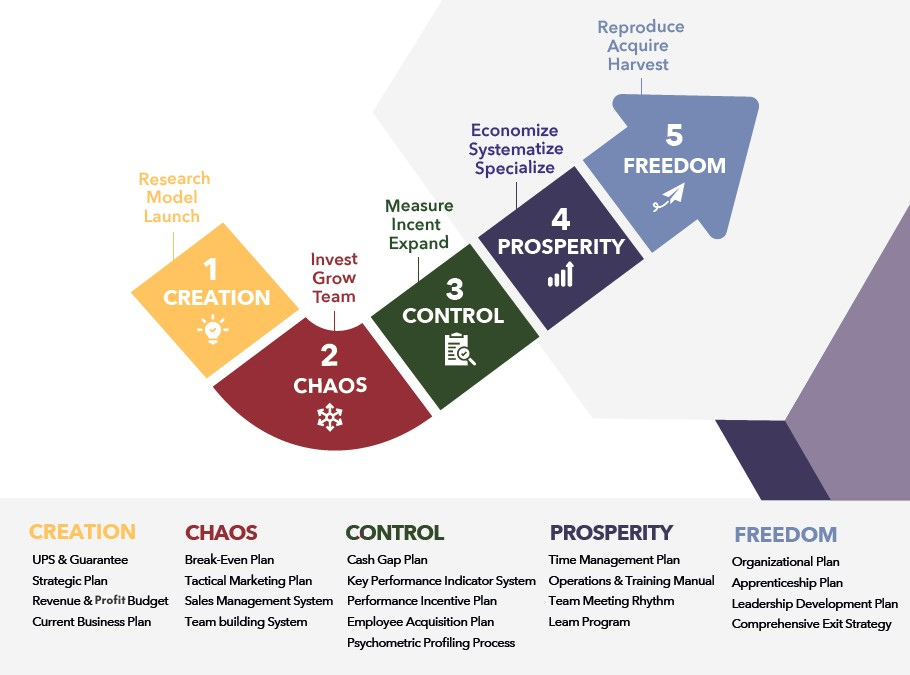
Free Methodology Presentation: Learn Our Proven 5-Step System For Transforming Your Business Into A Firm That Runs Smoothly, Profitably and (mostly) Without You
Free Methodology Presentation: Learn Our Proven 5-Step System For Transforming Your Business Into A Firm That Runs Smoothly, Profitably and (mostly) Without You.
Confirm Your Details To Continue
Confirm Your Details To Continue
Schedule a call to see if our approach can help take your business to #1 in your market.
No pie-in-the-sky. No generic ideas.
No hard sell.
Just straight-forward analysis of your approach to marketing and sales, team-building skills, gross and net profitability, and business transfer readiness.