
SUCCESS!
You have been scheduled!
Thank-you for letting technology do the hard work for us :-)
Please check your email for confirmation.
Learn More
about Trent
from his blog

You Don’t Need More Ideas - You Need Fewer (And Better Execution)
Most business owners don’t have an ideas problem.
They have an execution problem disguised as one.
The thing slowing growth is often not a lack of opportunity, it’s the opposite.
Across most growing businesses I work with the pattern is surprisingly similar: there is no shortage of ideas. There are marketing ideas. Growth ideas. New offers. New platforms. New partnerships. New opportunities appearing every other week.
And to be fair, many of them are good ideas.
That is exactly what makes this so dangerous.
Because in many cases, the very thing that makes a business owner capable, ambitious, and opportunistic is also the thing that fragments their attention and slows their growth.
This is something many business owners fall into. I have seen versions of it repeatedly in client work, and frankly, it is an easy trap for any driven person to drift into.
Not because they are lazy.
Not because they lack intelligence.
But because they can see too many viable paths at once.
The “Too Many Good Ideas” Pattern
You might recognise this.
You start something new.
It feels exciting.
You make some progress.
Then another idea appears.
Before the first thing is fully working, you shift your attention. Not because the original idea was poor, but because the new one feels more promising, more interesting, or more urgent.
So now you have multiple things in motion…
…but nothing fully built.
At first, it feels productive.
You are moving.
You are creating.
You are responding.
You are staying proactive.
From the outside, it can even look like momentum.
But over time, what often starts as energy turns into distraction. Then inefficiency. Then frustration. Then the familiar feeling many owners quietly carry around: busy, stretched, and wondering why the results are not matching the effort.
That is where confidence can start to erode.
Not all at once.
Just gradually.
You begin second-guessing what to focus on. You question whether the strategy is wrong. You wonder whether you need a different channel, a different offer, or a different plan.
Often, the real issue is not that the business lacks potential.
It is that the potential is being split too many ways.
Why Capable Business Owners Get Stuck
This is rarely a capability issue.
In many cases, it is the opposite.
The more capable you are, the more opportunities you can see. The more ideas you generate. The more directions you could go. And without strong constraints, that capability can start working against you.
What I tend to see is this: capable owners are not usually short on insight. They are short on protected focus.
They know enough to spot opportunity early.
They move quickly.
They are resourceful.
They back themselves.
But that strength creates a hidden risk.
When you can make almost any initiative work to some degree, it becomes harder to decide which one deserves your full attention.
So instead of committing hard to one or two high-leverage priorities, you keep several alive at once.
Each one gets some energy.
None gets enough.
The Mechanism: Why Progress Keeps Resetting
This is where the cost becomes less visible, but more damaging.
In most cases, every new initiative resets part of the learning curve.
Not entirely. But enough.
You re-enter trial and error.
You interrupt momentum.
You split attention.
You leave early-stage gains before they have time to compound.
So instead of one initiative building strength over time, you end up with several operating at partial effectiveness.
Busy, but not compounding.
That distinction matters.
Because businesses do not usually grow from activity alone. They grow when the right activities are repeated long enough to become efficient, measurable, and scalable.
Starting things can create movement.
Starting things alone does not usually create meaningful growth.
Staying with the right things long enough to optimise them - that is where the lift tends to happen.
The Hidden Cost of Playing It Safe by Staying Busy
This is the part many business owners miss.
Having multiple ideas in play can feel ambitious. It can even feel safer, as though keeping several options alive reduces risk.
But more often than not, it creates a different kind of risk: diluted execution.
And that cost tends to show up in predictable ways:
revenue grows, but at a fraction of its potential
results stay inconsistent
team focus becomes blurred
decision-making gets slower
follow-through weakens
cashflow becomes harder to forecast confidently
the owner feels mentally cluttered most of the time
In practical terms, what could have been 20–30% growth from one well-executed initiative can easily become 5–10% growth spread across several half-developed ones.
That is not because the ideas are bad.
It is because none of them get the depth of attention required to really work.
I was speaking recently with a business owner who had:
a strong core service already producing results
a second channel beginning to gain traction
and a third idea already being explored
All three had real potential.
But none of them were fully optimised.
The core offer still had room to improve conversion. The second channel had not yet been systemised. The third idea was already pulling energy before the first two had been fully built.
Instead of one channel compounding strongly, they had three channels each operating at roughly 30–40% effectiveness.
Individually promising.
Collectively inefficient.
That is the trap.
The Real Constraint Is Usually Not Knowledge, It’s Focus
Most businesses do not have a pure knowledge problem.
They already know many of the things they need to do.
They know they should:
follow up leads more consistently
tighten the sales process
improve delegation
hire support at the right time
double down on what is already working
hold a regular rhythm of review and accountability
But knowing is not the same as executing.
Execution is often less about discovering the next idea and more about deciding what will not get your attention right now.
That is the uncomfortable part.
Because every time you say yes to something new, you are also saying no to depth on something already in motion.
Without clear constraints, everything starts to feel important.
And when everything feels important, nothing gets the concentration it needs to really perform.
This is why, in coaching, we often use a 90-day planning rhythm. Not because a business only has a few things to do, but because most businesses can only truly execute a few meaningful priorities at a high standard at any one time.
That is a very different lens from simply staying busy.
A Better Way to Think About Focus
You have probably heard the “rocks in a jar” analogy.
It is simple. But it is useful because most businesses operate in reverse.
They fill their time with:
reactive work
low-value admin
new ideas
small requests
urgent-but-not-important tasks
Then they try to fit the important strategic work in around the edges.
That rarely works for long.
A more effective approach is to identify the few priorities that will materially move the business forward over the next 90 days, and then organise time, resources, and attention around those first.
With clients, that often means limiting focus to 3 to 5 meaningful priorities for the quarter.
Not because the business only has 3 to 5 things to do.
But because those are usually the only 3 to 5 things that will create disproportionate progress right now.
Everything else is consciously deprioritised.
Not forever.
But for now.
That distinction matters.
Focus is not about eliminating options.
It is about sequencing them properly.
What You May Need to Let Go Of (For Now)
This is where many owners hesitate.
Because it requires trade-offs.
You cannot do everything at once. And trying to do so is often the very thing slowing the business down.
At some point, you need to get comfortable saying:
Not now.
That might mean:
pausing a new offer
stepping away from an additional marketing channel
delaying a side project that is interesting but not essential
resisting the urge to rebuild something that is already working well enough
stopping a low-return initiative that keeps consuming mental space
This is simple.
But it is not easy.
Most owners understand it intellectually.
Applying it in real time, especially when new opportunities keep appearing, is much harder.
That is also why this needs to be approached with some self-respect.
This is not about beating yourself up for having ideas. Ambitious business owners are supposed to see opportunity.
The skill is not having fewer ideas naturally.
The skill is becoming disciplined enough to decide which ideas deserve action now, and which ones need to wait.
From Ideas to Execution: A Practical Approach
If you want to move from scattered effort to meaningful progress, the shift is not necessarily complicated.
The discipline is where the work is.
1. Choose your primary vehicle
What is the main driver of growth in the business right now?
Is it your core service?
A proven referral source?
A sales process that needs tightening?
A team capability issue that is holding everything else back?
Pick the primary vehicle.
Everything else should either support it or be consciously deprioritised for the time being.
2. Set 3–5 priorities for the next 90 days
Not 10.
Not every idea worth exploring.
Just the few priorities that, if executed properly, would materially move the business forward.
This is the logic behind 90-day ‘Rocks’: reduce noise, create clarity, and make execution measurable.
3. Define what “done” actually means
Not “work on it”
Not “make progress”.
Define outcomes.
For example:
“Sales process documented, implemented, and used consistently across all new leads for the next 30 days”.
That is far more useful than a vague intention.
4. Build a weekly execution rhythm
Review progress weekly.
Ask:
What moved?
What stalled?
What is blocked?
What needs to change?
Consistency over time usually beats short bursts of intensity.
This is where execution stops being motivational and starts becoming operational.
5. Expect boredom
This is the part many people do not talk about.
Execution is repetitive.
It is not always exciting.
It is not always novel.
It is not always stimulating.
That is not a bad sign.
In many cases, it is actually a good one.
Because compounding usually only happens when you stay with something long enough to refine it, improve it, systemise it, and scale it.
If you are constantly chasing the next spike of excitement, you may be stepping away just before the real return begins.
The Real Shift
Ideas are exciting.
Execution often is not.
But the businesses that grow are usually not the ones with the most ideas. They are the ones that stay with the right ideas long enough to make them work.
That requires:
discipline
restraint
patience
a willingness to ignore attractive distractions for a period of time
Because growth rarely comes from doing more.
More often, it comes from doing fewer things properly, for long enough, with enough repetition for the results to compound.
What To Do Next
If this feels familiar, start here:
List everything currently on your plate.
Identify the 3 priorities that matter most over the next 90 days.
Pause, defer, or remove the rest.
Define what “finished” looks like for each priority.
Put a weekly accountability rhythm around execution.
Because for most capable business owners, the issue is rarely a lack of ideas.
It is the discipline to follow through consistently on the right ones.
Final Thought
You are probably not short on ideas.
If anything, you may have too many.
Your next level of growth is unlikely to come from discovering something completely new. It will more likely come from executing what you already know; properly, consistently, and long enough for the business to benefit from the compounding effect.
If you are currently juggling multiple growth initiatives and not seeing the return you expected, that is exactly the kind of situation worth stepping back and reviewing properly.
I offer a complimentary coaching session to qualifying business owners who want clarity on where to focus next.
In that session, we will look at what is currently competing for your attention, identify the highest-impact priorities, and map out 1–3 practical next steps you can take over the next 90 days to move forward with more clarity, structure, and momentum.
No pressure. No hard sell.
Just a structured conversation.

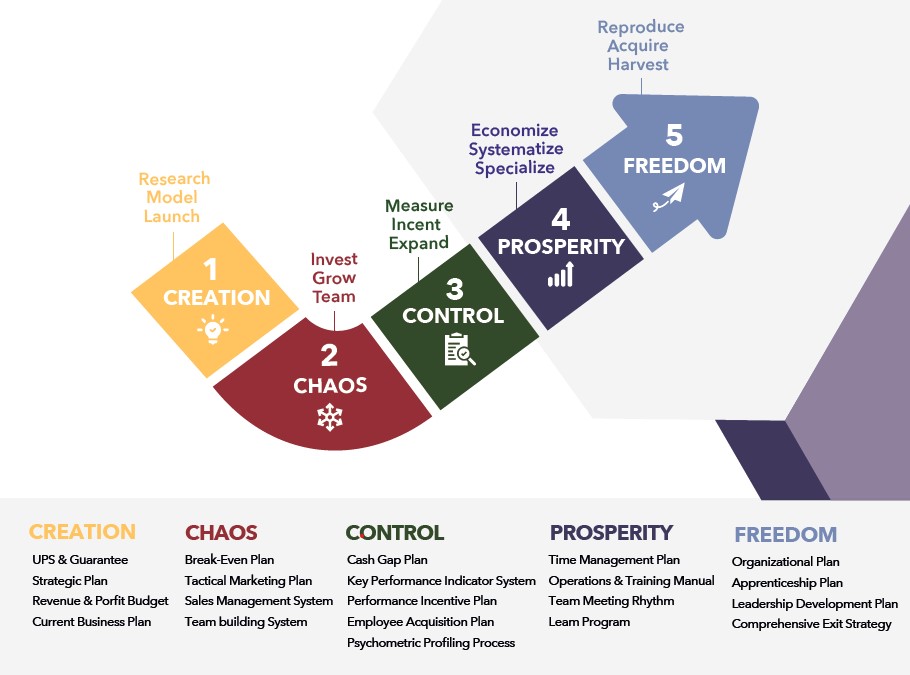
Free Methodology Presentation: Learn Our Proven 5-Step System For Transforming Your Business Into A Firm That Runs Smoothly, Profitably and (mostly) Without You
Free Methodology Presentation: Learn Our Proven 5-Step System For Transforming Your Business Into A Firm That Runs Smoothly, Profitably and (mostly) Without You.
Confirm Your Details To Continue
Confirm Your Details To Continue
Schedule a call to see if our approach can help take your business to #1 in your market.
No pie-in-the-sky. No generic ideas.
No hard sell.
Just straight-forward analysis of your approach to marketing and sales, team-building skills, gross and net profitability, and business transfer readiness.