
BLOG
BLOG

The Valley of Disappointment: What to Do When Effort Isn’t Paying Off (Yet)
At some point, almost every business owner reaches this moment:
“I’m doing the right things.
I’m more focused than I used to be.
So why does it feel like nothing is working yet?”
That feeling is heavier than frustration.
It’s doubt. Quiet, nagging doubt.
And it’s one of the most dangerous moments in business. Not because you’re wrong, but because you’re early.
Why Effort and Results Don’t Line Up
Most of us expect progress to work like this:
Effort goes in.
Results come out.
Repeat.
That expectation makes sense. It’s how we’re wired.
But in business, effort and results rarely move together in real time.
Early effort usually creates:
Awareness
New habits
Better decisions
Improved capability
What it doesn’t immediately create is visible payoff.
That gap — between effort and evidence — is where the trouble starts.
Welcome to the Valley of Disappointment
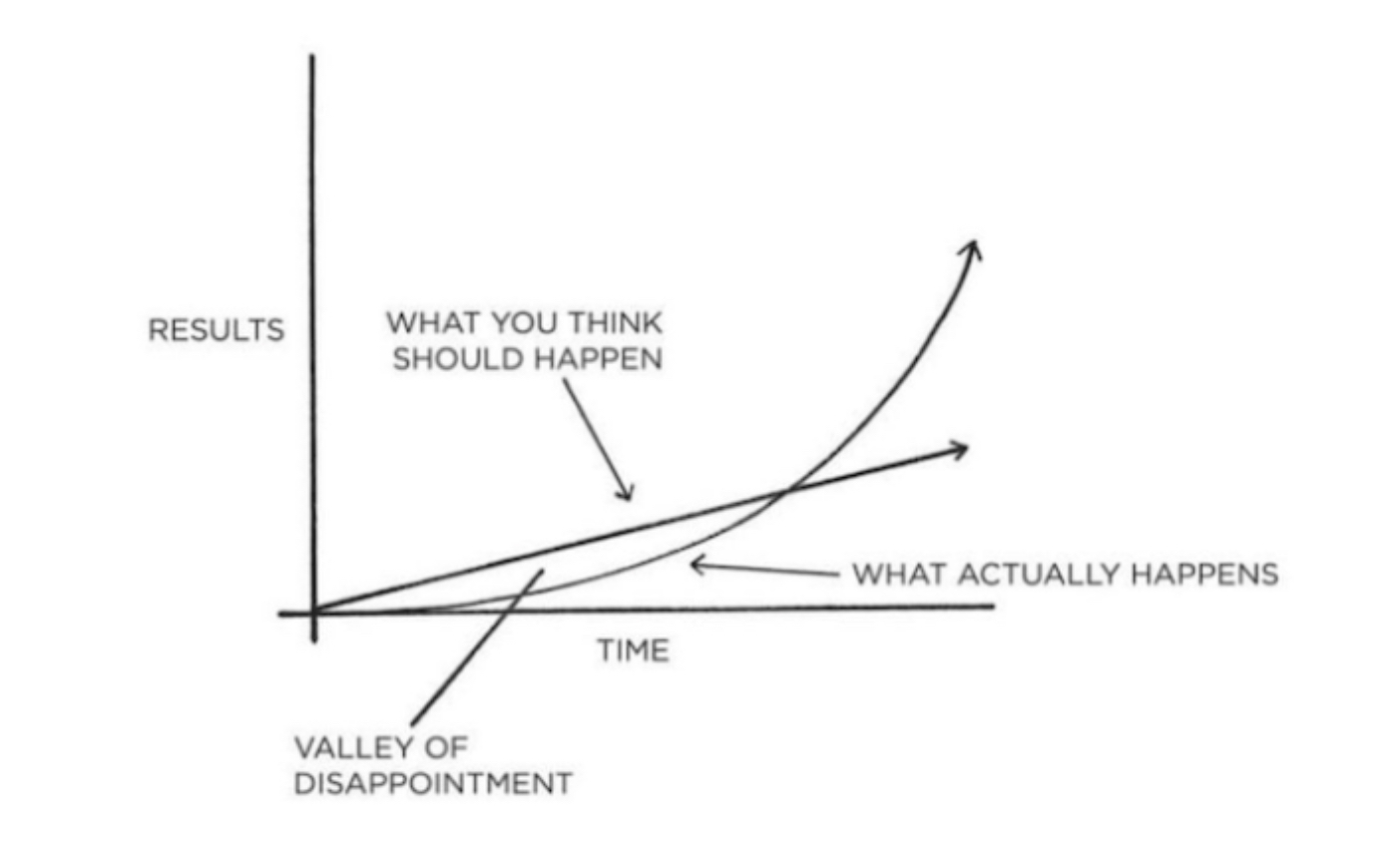
James Clear calls that gap the valley of disappointment.
It looks like this:
It’s the phase where:
You’re working harder or more deliberately than before
Old shortcuts no longer work
New systems feel clunky and slow
Results haven’t caught up yet
From the outside, it can look like nothing is happening.
From the inside, it can feel like learning new skills, and ‘trying on’ new concepts, is making things worse.
This is where many capable owners quietly retreat back to what is familiar. Not because the strategy is wrong, but because the story in their head turns against them.
The Real Risk Isn’t Failure, It’s Meaning
The valley doesn’t attack your ability.
It attacks meaning.
This is where thoughts creep in like:
“Why did I even start this?”
“Was I better off before?”
“Maybe I’m overcomplicating things.”
That is the crisis of meaning moment.
And it often leads to predictable reactions:
Changing direction too soon
Adding more initiatives
Abandoning structure for familiarity
None of those responses are irrational.
They’re human.
But they usually make the valley deeper, not shorter.
Time Is Still Doing Its Job
Even with good strategy, time is still required.
You can optimise your approach.
You can focus your effort.
But you can’t compress every outcome.
Early in the process, the work feels heavy and unrewarded.
Later on, the same work produces results with far less effort.
That’s not luck.
That’s compounding.
The mistake is assuming that because results are quiet, progress has stopped.
What This Looks Like in Real Businesses
I see this pattern often.
An owner brings more structure into their week.
They get clearer on priorities.
They stop reacting to everything.
But instead of immediate relief, they feel exposed.
They notice inefficiencies they used to ignore.
They feel slower because they’re being more deliberate.
They start wondering if it’s worth it.
The turning point usually comes when they don’t overreact.
They narrow the focus.
They stay consistent.
They resist the urge to add more pressure.
That is when momentum starts to accelerate. Quietly at first, then more obviously.
How to Behave Inside the Valley
When you’re in the valley, behaviour matters more than motivation.
Here’s a simple framework:
1. Zoom out before you judge
Look at months, not days. Ask what is improving beneath the surface.
2. Reduce, don’t add
Fewer priorities. Fewer experiments. More follow-through on the relatively few things that actually matter.
3. Stay in rhythm
Consistency beats intensity. Systems beat willpower.
This isn’t about pushing harder.
It’s about staying steadier.
What Not to Do
A few traps to avoid while you’re here:
Don’t constantly change direction
Don’t assume discomfort means danger
Don’t raise the bar on yourself unnecessarily
Don’t confuse patience with passivity
The valley is uncomfortable, not unsafe.
One important clarification
If things feel challenging right now, take heart: growth rarely feels smooth while you’re in it. Discomfort is often part of building a stronger, more capable business.
That said, don’t mistake financial distress for growth.
If your business is under serious cashflow pressure, struggling to meet obligations, or facing solvency risk, the right move isn’t to “push through”. It’s to get clear, early advice. In some situations, speaking with a licensed turnaround or insolvency professional sooner rather than later is a sign of leadership, not failure.
What to Do Next
If effort feels high and payoff feels low right now, pause before you make any big calls.
Ask yourself:
Am I early in a process that needs time?
What skill might still be installing?
What would “stay the course” look like for the next 90 days?
Most breakthroughs don’t happen before the valley.
They happen after it.
The valley of disappointment isn’t a signal to stop.
It’s often the chapter that explains the breakthrough.
And if the doubt is getting loud, that is usually a sign you shouldn’t be navigating this phase alone.

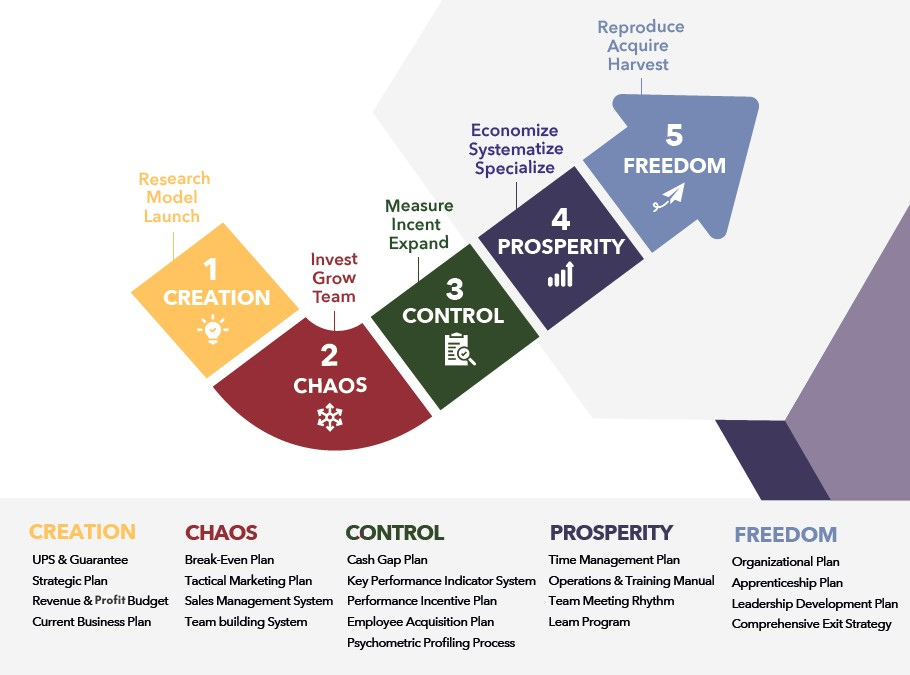
Free Methodology Presentation: Learn Our Proven 5-Step System For Transforming Your Business Into A Firm That Runs Smoothly, Profitably and (mostly) Without You
Free Methodology Presentation: Learn Our Proven 5-Step System For Transforming Your Business Into A Firm That Runs Smoothly, Profitably and (mostly) Without You.
Confirm Your Details To Continue
Confirm Your Details To Continue
Schedule a call to see if our approach can help take your business to #1 in your market.
No pie-in-the-sky. No generic ideas.
No hard sell.
Just straight-forward analysis of your approach to marketing and sales, team-building skills, gross and net profitability, and business transfer readiness.