
BLOG
BLOG
You Cannot Build a Better Business While Reacting All Week
Most business owners aren’t lazy.
They’re overloaded.
Their week gets consumed by staff questions, client issues, emails, quoting, admin, cash flow concerns, unexpected problems, and the constant pressure of trying to keep everything moving.
By Friday afternoon, many owners feel exhausted… yet strangely frustrated.
Because despite working hard all week, the important work still didn’t happen.
The strategic work.
The improvement work.
The work that actually changes the future of the business.
And that’s the trap.
One of the patterns I repeatedly see is intelligent, capable business owners trying to solve reactive businesses by working harder inside the same operating system that created the chaos in the first place.
More effort.
More hours.
More availability.
More problem solving.
But very little structural change.
That works for a while.
Until it doesn’t.
The Real Problem Usually Isn’t Awareness
Most business owners already know what needs to happen.
They know they should:
improve marketing
tighten systems
follow up leads more consistently
delegate more
improve cash flow forecasting
refine their sales process
spend more time leading the team
The issue usually isn’t intelligence or awareness.
The issue is that strategic work keeps getting squeezed out by operational urgency.
And over time, that creates a dangerous cycle.
The owner becomes the central nervous system of the business.
Every question flows upward.
Every problem requires their involvement.
Every decision interrupts something else.
Without realising it, many growing businesses unintentionally train the owner to operate permanently in response mode.
That has consequences beyond stress.
It creates:
decision fatigue
slower team development
owner bottlenecks
reduced capacity
margin pressure
inconsistent execution
dependency on the owner for momentum
In many cases, reactive businesses become harder to scale because the business itself becomes overly reliant on the owner’s constant intervention.
That’s one of the hidden costs of staying reactive for too long.
Why Intelligent Owners Stay Trapped
This is also why the problem is often harder to solve than it first appears.
Most owners are not choosing chaos deliberately.
They’re responding to genuine pressure.
Clients need answers.
Staff need support.
Cash flow matters.
Problems feel urgent because, in many cases, they are.
And during growth phases, some level of reactivity is normal.
But one of the biggest mistakes owners make is assuming the solution is simply to become more efficient at reacting.
It usually isn’t.
Because if the underlying operating rhythm never changes, the business often just becomes a faster version of the same problem.
The owner gets better at coping.
But the structure that created the overload remains intact.
The Business Often Follows The Structure Of The Owner’s Week
A business is influenced by many things:
leadership,
systems,
market conditions,
financial resources,
team capability.
But one of the clearest indicators of future direction is often the owner’s calendar.
Owners frequently tell me they want:
growth,
better systems,
stronger leadership,
improved profitability,
less stress,
more control.
But when we look at their week, there is almost no protected time allocated to building those outcomes.
No space for:
strategic thinking
process improvement
leadership development
financial review
planning
marketing development
recruitment
systemisation
The entire week gets consumed by operational activity.
And eventually, activity starts replacing direction.
It’s a bit like trying to renovate a house while never putting the tools down long enough to review the plans.
“When Things Calm Down” Usually Never Comes
A lot of owners tell themselves:
“Once things settle down, I’ll focus on improving the business.”
But business rarely calms down by itself.
Often, the opposite happens.
As the business grows:
complexity increases
communication layers increase
interruptions multiply
team dependency expands
operational noise compounds
Without intentional structure, the owner gradually becomes the bottleneck the business cannot outgrow.
Owners are often surprised to discover that the business problem is no longer just workload.
It’s owner dependency.
And owner dependency eventually impacts:
profitability,
scalability,
leadership depth,
culture,
succession,
and long-term business value.
The Shift Happens When Owners Protect Strategic Thinking Time
One of the biggest turning points for many business owners is learning the difference between:
Working in the business
vs
Working on the business.
Both matter.
Operational execution matters.
Client delivery matters.
Problem solving matters.
But if all of the owner’s energy gets consumed inside day-to-day operations, the machine itself never improves.
That’s where protected strategic time becomes critical.
Not leftover time.
Not “when things settle down.”
Scheduled time.
Protected time.
Time specifically reserved for:
strategic planning
financial forecasting
reviewing numbers
leadership development
process improvement
recruitment
marketing development
operational refinement
One of the simplest tools I often recommend to clients is building what I call a “Default Diary.”
A pre-structured weekly calendar that protects the highest-value activities before operational chaos fills the gaps.
Why?
Because what gets scheduled usually gets done.
And what remains unscheduled usually gets consumed by urgency.
Most Owners Don’t Need More Time. They Need More Leverage.
That distinction matters.
Some business owners genuinely are under enormous pressure:
staffing shortages,
financial constraints,
operational complexity,
family responsibilities.
This is not about pretending those realities do not exist.
But for many owners, the deeper issue is not total hours.
It’s how their time, attention, and decision-making capacity are being allocated.
One of the patterns I commonly see is owners continuing to perform $30/hour operational tasks inside businesses trying to become $3M+ organisations.
That creates a ceiling.
Because businesses rarely outgrow the structure of the owner’s role.
At some point, the owner has to evolve from:
primary operator,
toleader,
strategist,
and allocator of resources.
That transition is uncomfortable.
But necessary.
The Three Decisions That Usually Create Breathing Room
One framework I often walk through with clients is what I call the Three D’s.
Not as a productivity “hack.”
As a leverage framework.
1. Delegate
What can someone else do competently, even if they do it differently than you would?
Many owners unintentionally create team dependency by refusing to release operational control.
But if the owner remains involved in every decision forever, the business eventually stalls at the level of the owner’s capacity.
2. Defer
What genuinely matters right now?
Reactive businesses often lose enormous energy to context switching and low-consequence urgency.
Not everything that feels urgent is strategically important.
3. Delete
What activities should stop entirely?
Some tasks create movement.
Others create progress.
They are not the same thing.
One of the most commercially valuable skills a business owner can develop is learning to identify which activities actually move the business forward, and which ones simply create operational noise.
You Cannot Improve The Business Without Space
Here’s the hard truth:
You cannot build a better business while reacting all week.
Not consistently.
Improvement requires:
thinking space
emotional bandwidth
strategic review
implementation time
uninterrupted focus
Because good decisions rarely happen in survival mode.
Neither does innovation.
Neither does leadership development.
Neither does strategic clarity.
That doesn’t mean disappearing to a beach for six months.
Sometimes the shift begins with something much smaller.
Two protected hours on a Friday morning.
A recurring financial review session.
A weekly leadership meeting.
A blocked strategic planning session.
Small structural shifts often create disproportionately large operational improvements over time.
The Goal Isn’t Perfection
The goal is not to become perfectly organised overnight.
The goal is to stop operating in permanent reaction mode.
Because once owners create even a small amount of strategic space:
decisions improve
stress often reduces
leadership strengthens
clarity increases
team capability grows
momentum returns
opportunities become easier to see
The business starts feeling more intentional again.
Less chaotic.
Less dependent on constant owner intervention.
And often, more commercially stable and profitable as a result.
Start Smaller Than You Think
If this resonates, resist the temptation to redesign your entire life overnight.
Start smaller.
Block one recurring session in your calendar this week to work on the business.
Protect it like you would an important client meeting.
Then use that time to ask:
What is creating the most operational pressure right now?
Where am I becoming the bottleneck?
What should I stop doing?
What needs a stronger system?
What would create the most leverage if improved?
You do not need perfect answers immediately.
Most business improvement starts with creating enough space to think clearly again.
Because clarity changes decisions.
Better decisions improve structure.
And better structure changes the trajectory of the business over time.

Free Methodology Presentation: Learn Our Proven 5-Step System For Transforming Your Business Into A Firm That Runs Smoothly, Profitably and (mostly) Without You
Free Methodology Presentation: Learn Our Proven 5-Step System For Transforming Your Business Into A Firm That Runs Smoothly, Profitably and (mostly) Without You.
Confirm Your Details To Continue
Confirm Your Details To Continue
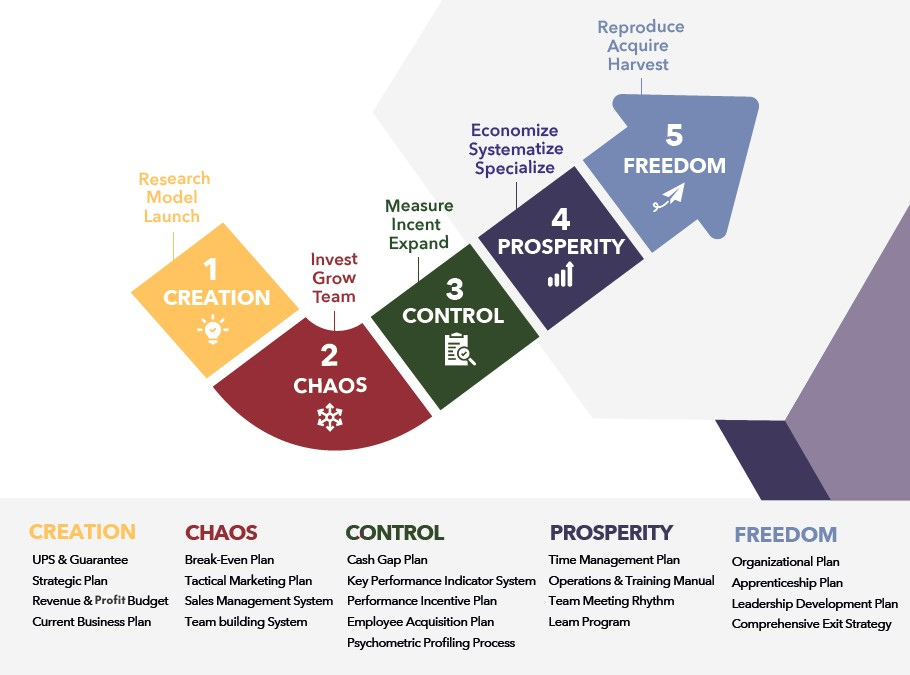
Schedule a call to see if our approach can help take your business to #1 in your market.
No pie-in-the-sky. No generic ideas.
No hard sell.
Just straight-forward analysis of your approach to marketing and sales, team-building skills, gross and net profitability, and business transfer readiness.