
BLOG
BLOG
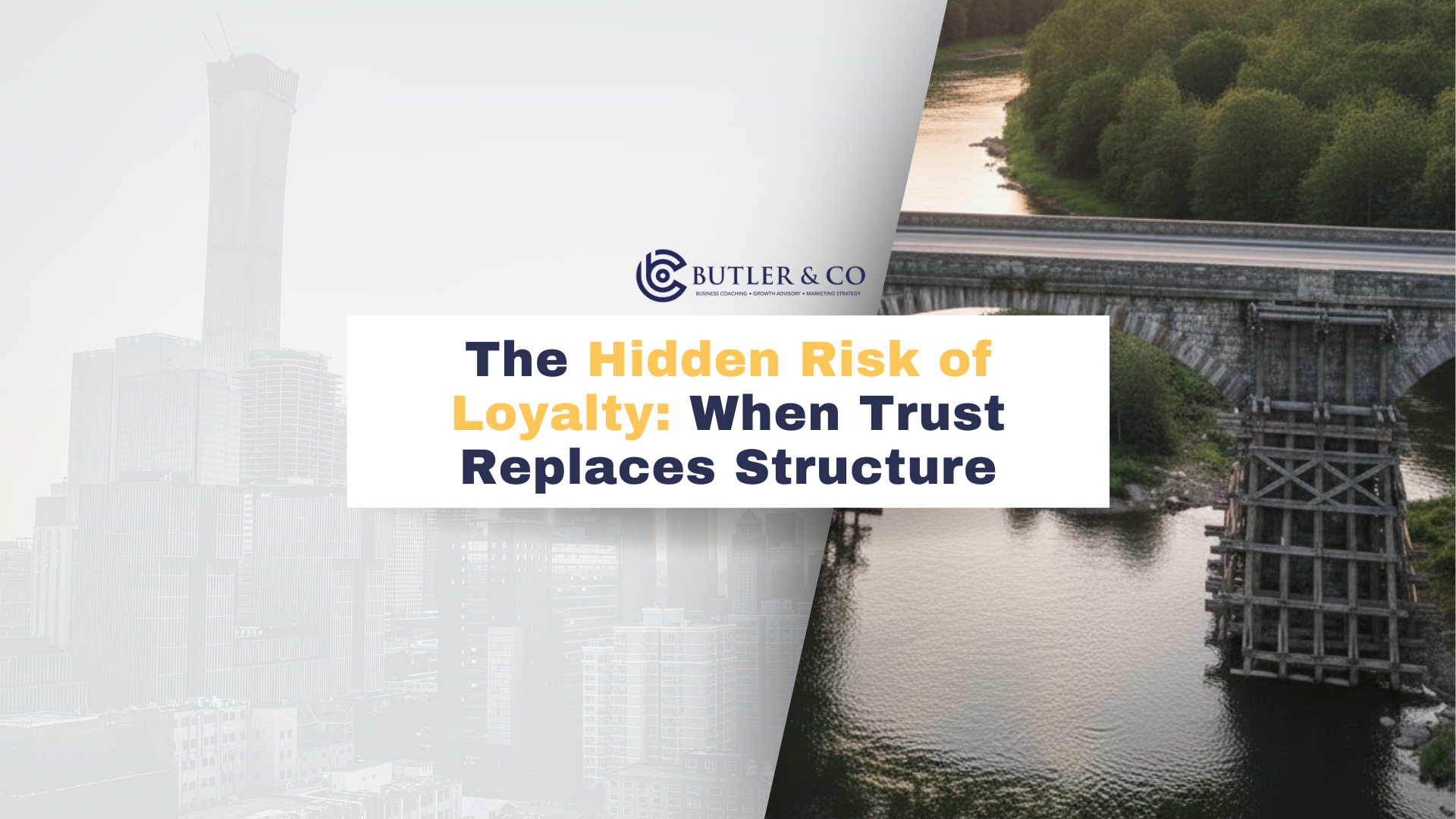
The Hidden Risk of Loyalty: When Trust Replaces Structure
Most businesses don’t break because of bad people.
They break because good people were trusted without structure.
They’re built on loyalty.
Long-term staff.
Shared history.
People who’ve “been there from the start.”
And that loyalty is a good thing.
But as a business grows beyond the founder-and-core-team stage, something subtle can happen:
Loyalty starts replacing structure.
And that’s when risk quietly creeps in.
Not because anyone’s doing the wrong thing -
but because the stakes are higher now.
Why Loyalty Feels Like Safety
In the early years, trust is everything.
You hire carefully.
You work side by side.
You solve problems together.
Roles blur - but it works.
Communication is fast.
Decisions are informal.
Accountability is personal.
Many founders describe it as:
“We’re like a family.”
And for a while, that model performs extremely well.
The Shift Most Founders Don’t See Coming
In many service businesses, growth doesn’t arrive with drama.
It arrives with complexity.
More projects running at once.
More clients.
More money at stake.
More moving parts.
Longer delivery timelines.
Bigger commitments.
But here’s the issue:
The structure often doesn’t evolve at the same pace as the growth.
So what fills the gap?
Personal influence.
Tenure.
Unspoken authority.
Instead of defined accountability, you get informal hierarchy.
And while informal hierarchy can “work” for a season, I’ve seen repeatedly that it creates hidden dependency - and increases concentration risk.
This is not a sign you’ve done something wrong.
It’s a sign you’ve grown.
What Concentration Risk Looks Like (In the Real World)
Here’s a composite scenario I’ve seen in founder-led service firms more times than I can count:
There’s a long-term team member - smart, loyal, capable - who quietly becomes the operational glue.
They know the clients.
They know the process.
They know which corners get cut to “make it work.”
No one officially reports to them.
No one has given them clear decision rights.
But everyone defers to them anyway - because it’s faster.
Then they take two weeks of leave.
Suddenly:
Approvals stall.
Clients start chasing updates.
Small mistakes creep in.
Turnaround times blow out.
The founder gets pulled back into the weeds “just to keep things moving.”
That’s concentration risk.
Not theoretical.
Commercial.
It shows up as:
Revenue interruption (work slows, invoicing delays, pipeline suffers)
Client churn risk (service quality drops, comms get messy)
Margin erosion (rework, firefighting, founder time becomes unbillable time)
Founder burnout (you become the safety net again)
Valuation discounts (buyers and banks don’t love key-person dependency)
And it rarely announces itself - it just quietly increases exposure until pressure hits.
The Three Hidden Risks of Loyalty-Driven Businesses
This isn’t about distrusting your people.
It’s about recognising structural exposure.
And to be clear: loyalty matters.
Tenure matters.
History matters.
The risk is not loyalty - the risk is loyalty becoming the operating system.
1) Authority Is Informal, Not Defined
There’s usually someone who “just knows how things work.”
People defer to them -
not because their role is clearly defined,
but because of history.
When they take leave, approvals stall.
When they resign, five people suddenly realise they were relying on undocumented knowledge.
Everything slows down - not because the team lacks talent, but because authority was never structurally assigned.
2) Promotions Happen by Trust, Not Design
Long-term team members often move up naturally.
They’ve earned it.
They’ve proven loyalty.
They’ve been in the trenches.
This is common - and understandable.
But operating skill doesn’t automatically equal leadership capability.
And tenure doesn’t replace seat design.
When promotions happen without redefining the role clearly, you don’t gain structure.
You gain expectation without clarity.
The result?
Confusion.
Mixed signals.
Quiet frustration.
A heavy load for the person promoted — and everyone around them.
3) Founders Avoid Formalisation
Many owners resist formal structure because it feels:
Corporate
Bureaucratic
“Not us”
And emotionally, I get it.
It can feel disloyal to introduce structure.
It can feel like you’re questioning the very people who helped you build the business.
But in my experience, clarity strengthens culture more often than it weakens it.
Because when there’s no clarity, the founder becomes the referee.
The safety net.
The final decision-maker on everything.
And quietly, pressure builds.
Trust Is Not a Risk Management Strategy
Trust is relational.
Structure is protective.
You can trust someone deeply - and still need:
Clear accountability
Defined decision rights
Financial oversight
Measurable standards
As businesses grow, exposure grows.
Bigger contracts.
Bigger commitments.
Longer delivery timelines.
And in most cases, that exposure calls for structure -
not because you distrust your people,
but because the stakes are higher.
The Maturity Shift
Early stage:
“We trust each other.”
Growth stage:
“We define who owns what.”
Mature stage:
“We trust each other within clear structure.”
That’s a significant leadership evolution - especially for founders who built their business on relationships.
Many of the strongest teams I work with go through this exact shift.
It requires stepping back and asking:
Are we running on trust…
or are we supported by design?
What Structural Maturity Actually Looks Like
It’s not 200-page manuals.
It’s not layers of red tape.
It’s clarity.
If you’ve worked with me, you’ll recognise the principle I come back to constantly:
one clear owner per seat, per function - not shared accountability, not “everyone sort of owns it.”
Structural maturity looks like:
One accountable leader per core function (for example, one clear owner for revenue, delivery, operations and financial performance - even if some of those seats are still held by the founder)
Clear role definitions that survive turnover
Decision-making that doesn’t default to tenure
Recruitment based on seat design - not personality comfort
When structure supports culture:
Promotions feel fair.
Expectations are clearer.
Pressure reduces.
And the founder stops being the safety net.
That’s not corporate.
That’s durable.
That’s resilience.
A Hard Question Worth Sitting With
If your most loyal, longest-serving team member resigned tomorrow…
Would the business hold?
Or would your stress spike immediately?
Your answer tells you something important.
Culture is powerful.
But culture without structure increases concentration risk.
Protecting Loyalty by Strengthening Structure
This isn’t about replacing loyalty.
It’s about protecting it.
Because when structure catches up with growth:
Loyalty becomes an asset, not a dependency.
Leaders are developed, not assumed.
And the business becomes structurally more resilient as it scales.
Maturity is rarely dramatic.
It’s structural.
And if this feels uncomfortably familiar, it’s often the next leadership evolution - not a crisis.
Want an Objective Lens on Your Structure?
If you’d value an objective, strategic view on where informal authority may be quietly replacing structural clarity in your business, we can look at it properly.
This is a strategic conversation - not an emergency.
Start with a brief 15–20 minute brainstorm call.
We’ll identify where dependency may be building and decide whether a deeper structural review makes sense.
Let’s strengthen the structure - so your culture can thrive.

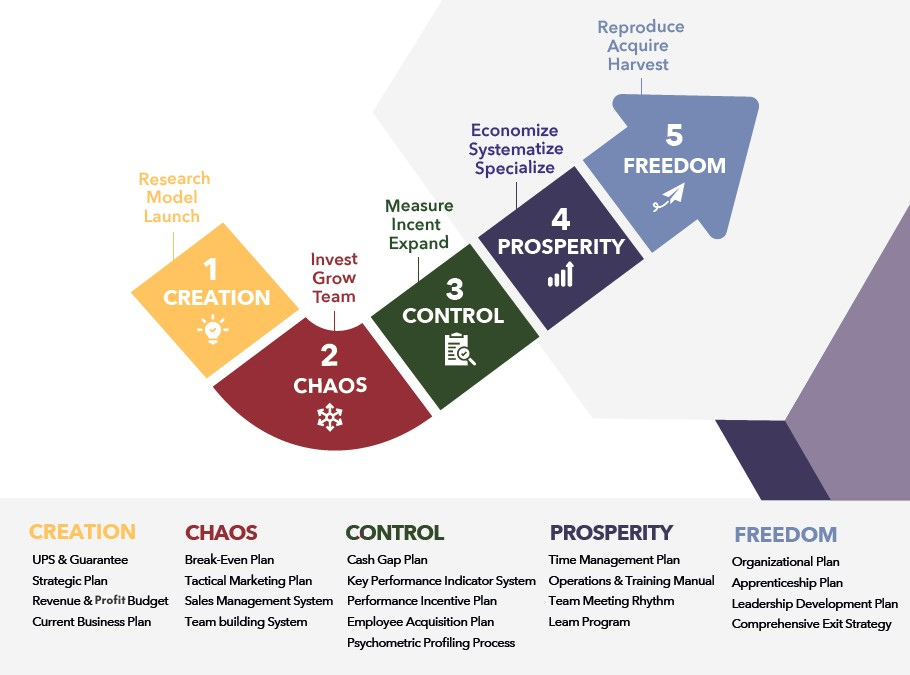
Free Methodology Presentation: Learn Our Proven 5-Step System For Transforming Your Business Into A Firm That Runs Smoothly, Profitably and (mostly) Without You
Free Methodology Presentation: Learn Our Proven 5-Step System For Transforming Your Business Into A Firm That Runs Smoothly, Profitably and (mostly) Without You.
Confirm Your Details To Continue
Confirm Your Details To Continue
Schedule a call to see if our approach can help take your business to #1 in your market.
No pie-in-the-sky. No generic ideas.
No hard sell.
Just straight-forward analysis of your approach to marketing and sales, team-building skills, gross and net profitability, and business transfer readiness.