
BLOG
BLOG

Sales Management Systems: The Key to Scale Into a High-Performing Business
How do you scale into a high-performing business? By having a reliable and efficient sales management system.
This practical system can help you build a top-performing sales force to navigate every stage in building your business - including the chaos stage. If that reference confuses you, I invite you to keep reading.
In this article, I want to share with you the sales management system that I teach my clients. I want to give you the key to achieving high-level sales through a professional approach to sales training. I’ll teach you how to use this game-changing solution to propel your business to the next level of growth and profitability.
What is a Sales Management System?
My definition of a Sales Management System (SMS) is simple. It’s a practical system that builds a top-performing sales force using 4 different techniques: scripting the sales approach, managing activities through CRM (customer relationship management) software, measuring individual performances and tying paychecks to results.
I created this system to streamline the sales process by offering your team clarity and accountability. If implemented correctly, this system will help your sales team stay on course and hit every single target and KPI.
Let’s take a look at the 4 techniques of this SMS.
Sales Approach Script
Having a successful sales team means having a clear and well-tested script for the sales process. This involves creating a written script or documented directive to guide the sales force in interacting with potential clients, delivering value and closing deals. This creates consistency in the sales process regardless of who is interacting with potential clients.
I always tell business leaders that selling is a science. When you create scripts and templates, you equip your team with the tools to help them perform at their best. You create a template that considers all possible scenarios and client demographics. It reduces the guesswork and allows your team to react confidently no matter how the conversation goes.
CRM for Activity Management
Customer Relationship Management (CRM) software helps you track the activity of your sales team. It’s an efficient solution to manage and monitor every client interaction and track the conversion rates. This allows you to see who is moving leads through the sales pipeline and who struggles with it.
The data from your CRM will give insights on how to improve the sales process. You can see where possible bottlenecks are and how to improve problematic areas. A CRM points out what should be replicated and eliminated to increase conversion rates and results.
Performance Metrics
What is measured can be improved. An SMS comes with a list of metrics to separate the high-performers from the not. It allows you to identify who cannot meet the metric standards - thereby allowing you to analyse issues that can be improved.
Through the data provided by the CRM solution, you can evaluate the performance of your sales team to see if they are hitting their targets. These performance metrics can include the number of calls made, emails sent, meetings set and deals closed. Each area can be tracked and analysed so you can make adjustments where it’s needed.
This also allows your team to set their own goals so it aligns with the business.
Results = Paycheck
Finally, the SMS solution that I teach ties the paycheck to the results. Your sales team should be clear on this. They should be aware that their pay is directly connected to their performance. The more they deliver results, the higher the pay. This motivator encourages your team to hit their targets because it’s not just the business that’ll benefit but also their wallets.
This moves away from offering a fixed salary as you set up a performance-based structure to promote accountability within the business.
How a Sales Management System Leads to Business Growth
Now let’s get to the good part - how does the SMS lead to business growth?
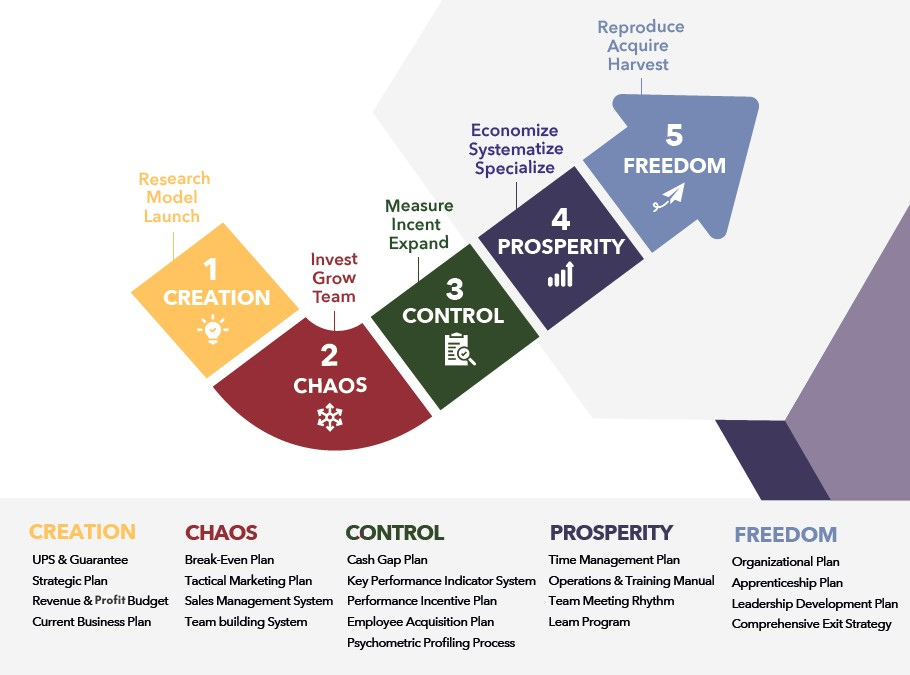
A typical business progress goes through the chaos phase. If you’re familiar with my work, I’ve taught my clients that business progression goes through 5 stages: Creation (creating or recreating phase), Chaos (solving problems), Control (expanding the business), Prosperity (operating with efficiency) and Freedom (running the business smoothly and seamlessly).

The SMS happens during the chaos phase. This is when you’re trying to grow, expand and improve the results and profitability of the business. At this point, you’ve encountered a bottleneck that could compromise the growth of the business. For instance, you find that your team isn’t performing as expected. Or your sales processes show inconsistencies in results. Or it could even be a poorly managed sales team.
Through the SMS, you have a structured system that allows you to take control of the process. By scripting the sales process, using a CRM solution to manage activities, measuring performance and tying paycheck to the results, you’re trying to overcome these issues to achieve a higher sales level in the business. You’re taking a professional approach to training your sales team so they can transform the business and achieve higher profitability.
The 3 “A’s” of High-Level Sales
So we’ve been talking about improving the sales force and building a high-performance team - but what does that mean?
If you want a top-performing team that can achieve high-level sales, you need to get three things right - I call them the “three A’s”. In case you’re not hitting your sales targets, it’s possible that one of these “A’s” needs improvement.
Attitude
Attitude in sales is everything. And I’m serious about this because I’ve seen how attitude drives different results every single time.
When I’m working with a sales team, I usually start by working on their mindset. The right mindset can effectively turn leads into paying clients.
This mindset transformation starts with the definition of selling. It’s not about tricking people into seeing the value of an offer. It’s about leading them through the process of identifying their issues and seeing the offer as the only solution.
This mindset cultivates a professional and positive attitude within the team. It treats the sales process, not as a mere transaction, but as a relationship-building process.
Activity
Ultimately, sales is a numbers game. The only way to keep the numbers high is through consistent activity. This is what I focus on after attitude.
Despite having the right mindset, a lack of activity won’t lead to results. Your sales team should make enough calls, send emails, attend meetings and engage with prospects regularly. The more conversations, meetings and presentations done, the higher the opportunity to close deals.
This is where your KPIs will come into play. Set clear expectations and targets so your team will know what it means to perform at a higher level.
Acumen
Acumen is all about doing the right thing. It’s not enough that the team is doing enough activity - it has to be the right activity.
For instance, your target market is housewives. Sending them emails won’t work as much as posting on social media or calling would do. Train your sales team so they have the professionalism, skill and tact to communicate with the target market at a level they understand.
Your team should also develop the ability to get the best out of themselves and execute the right sales approach script. They should learn how to navigate the conversation to shift the tone depending on how the potential client responds to the pitch.
Implementing the Sales Management System
With what you know of the SMS solution, how can you implement it in your business?
As a business coach, I would strongly suggest working with a professional because they have the expertise and experience to guide you through the process. Business coaches like me have spent hours perfecting systems focused on solving bottlenecks in the sales process.
But to keep this from being a shameless plug, I want to share an option that I’ve created so you can implement the SMS on your own.
The DIY Approach
Implementing the SMS solution requires you to understand your team first. Where do they currently stand in terms of the sales process, their activity levels and the compensation structure offered? Assess how these relate to the current results that your business is getting and identify areas for improvement.
Here’s a simple 3-step process that you can follow.
First, develop your KPIs. These Key Performance Indicators will help you measure the success of your team. This could include conversion rates, activity metrics and revenue targets. They can use this as a clear manual as they set activities to reach their goals.
Second, conduct a sales workshop. Training is very important if you want to improve your team. A workshop allows you to align the team with the new SMS that you’ll use. They have to learn how to use the new process so everyone understands how this will change the sales process and results. Take this time to ensure all questions, objections and resistance are addressed and clarified.
Third, roll out the SMS. Introduce the systems and processes that will be used by the SMS including the CRM software, sales approach scripts and performance-based compensation scheme. Track the team’s progress and make adjustments to support the momentum of growth.
Now, this 3-step process is generic and should be customised according to your specific business needs. In case you’re struggling with the DIY approach and you can’t see the expected changes, there’s another option you can use.
Work with a Business Coach
As mentioned, business coaches have these systems perfected and tested. I’ve rolled out the SMS solution in countless businesses and I can see where adjustments are required.
The combined experience and expertise of a business coach expedite the implementation of the Sales Management System. It shortens the learning curve because I already have specific activities and script templates that business leaders and sales teams can choose from. I also have a list of best practices that I’ve accumulated and observed over the years.
All these make the sales training more efficient and effective. It also comes with a support system that’ll keep educating and guiding your sales team throughout the process of implementation.
Transform Into a High-Performing Business
A Sales Management System is more than a tool, it’s a pathway you can use to create an efficient and scalable business. If you can structure your sales team’s approach and hold them accountable for their activities and results, you can experience a breakthrough in your business growth and development.
After all, the ultimate goal is not just to profit more - it’s to develop a high-performing business that can function seamlessly even without your daily input. The SMS solution that I offer will help you take one step closer to that goal.
So if you want to transform into a high-performing business, I encourage you to book a complimentary brainstorming session with me. We can discuss the 3 step process that you can use in the DIY approach - or you can go straight to my program so we can immediately customise a solution to take your business to the next level.
If you’re ready, book a complimentary call here: https://www.butleradvisory.com.au/time-with-trent.
Free Methodology Presentation: Learn Our Proven 5-Step System For Transforming Your Business Into A Firm That Runs Smoothly, Profitably and (mostly) Without You
Free Methodology Presentation: Learn Our Proven 5-Step System For Transforming Your Business Into A Firm That Runs Smoothly, Profitably and (mostly) Without You.
Confirm Your Details To Continue
Confirm Your Details To Continue
Schedule a call to see if our approach can help take your business to #1 in your market.
No pie-in-the-sky. No generic ideas.
No hard sell.
Just straight-forward analysis of your approach to marketing and sales, team-building skills, gross and net profitability, and business transfer readiness.