
BLOG
BLOG
From Technician to Owner: The Skill Shift Nobody Warns You About
Most people start a business for a simple reason: they’re good at what they do.
They’re tired of working for someone else.
They want autonomy.
They believe they can do it better.
And early on, that’s enough.
You win work. You deliver well. You build a reputation. Revenue comes in.
Then the business grows… and something quietly changes.
You’re still busy, sometimes busier than ever, but now you’re overwhelmed. Not because you’ve become worse at your craft, but because you’re no longer “just” the technician.
You’re the owner.
And nobody really warned you what that actually requires.
The Big Misunderstanding
Technical skill and business skill are not the same thing.
Said differently:
The technical work of a business and a business that does that technical work are two totally different things!
Being great at consulting, building, law, electrical work, design, or accounting doesn’t automatically make you great at:
managing cash flow
making hiring decisions
pricing for profit (not just revenue)
protecting your time
leading a team
building systems that don’t rely on you
Here’s the line most owners eventually learn the hard way:
The skill that got you here won’t get you there.
That’s not a criticism. It’s just the real progression.
The Three Stages Most Owners Go Through
Over the years, I’ve noticed a consistent pattern, and it tends to show up at predictable points of growth.
Stage 1: The Doer
Typically: under ~$500k revenue, no staff (or the occasional subcontractor)
You do everything.
You win the work. Deliver the work. Invoice the work.
Revenue is directly tied to your personal effort.
You’re busy, but you feel some sense of control - because YOU are the system.
It can feel productive, but you’re typically putting in long hours and working hard.
Stage 2: The Overloaded Operator
Typically: ~$500k–$3.0m revenue, 2–15 staff, “we’ve grown… but it’s messier”
You hire. Revenue increases.
But complexity increases faster.
Now you’re doing the technical work plus:
fixing other people’s work
quoting late at night
answering emails constantly
managing personalities
wondering where the profit went
This is where many good businesses stall.
Not because the owner is incapable.
Because they haven’t made the skill shift.
A common example: I once worked with a trades business turning over around $780k with four staff . The owner was still on the tools 35 hours a week, quoting after dinner, and constantly “saving” jobs that should’ve been handled by the team. Revenue looked fine, but cash was tight, margins were unclear, and the business couldn’t breathe without him.
That’s Stage 2 in a sentence: the business grows… but the owner’s role doesn’t evolve with it.
Stage 3: The Deliberate Owner
Typically: the owner steps back from being the bottleneck and starts running with rhythm
This stage doesn’t require more effort.
It requires new abilities:
understanding the numbers (not just the bank balance)
knowing gross margin by service line
pricing with intention
hiring with structure
delegating clearly
building a repeatable operating rhythm
And it doesn’t happen by accident.
It happens when the owner decides to grow up, professionally, into the role.
The Shift Nobody Warns You About
Here’s the real shift:
You move from doing the work to designing the system that does the work.
That means stepping away, at least partially, from some of the things you’re best at.
And that is uncomfortable, because your identity is tied to competence.
You trust yourself on-site.
You’re confident in your craft.
You know what “good” looks like.
But then you’re confronted with new territories:
forecasting, margins, leadership, accountability, planning cadence.
So when pressure hits, most owners default back to what feels safe:
More doing.
More fixing.
More hands-on.
It’s understandable, and it’s also the trap.
Why Most Owners Don’t Make the Shift
It’s not laziness.
Most owners get stuck for three reasons:
1) Identity attachment
If you’ve always been “the best operator,” stepping back can feel like losing status - even if it’s the only path to scale.
2) Short-term revenue pressure
When cash feels tight, owners often double down on billable work instead of investing in structure. That decision makes sense today - and quietly creates pain for the next two years.
3) No systems thinking
Many owners don’t realise the real work now is designing repeatability: standards, roles, cadence, reporting, and clear decision rules.
And the cost of not shifting is simple:
the business becomes dependent on you.
Dependence limits freedom. It caps growth. And eventually it burns you out.
There is a blunt way to say it:
If you can’t step away, you don’t own a business. You own a job.
(That line is confronting, but it’s also the moment many owners finally tell the truth about what they’ve built.)
The Apprenticeship of Ownership
Running a business is an apprenticeship.
Not in your trade - in ownership.
Most people were never taught how to:
manage a cash gap without panic
model break-even properly
understand contribution margin
sequence hiring so payroll doesn’t strangle profit
structure a week so strategic work actually happens
build systems others can follow consistently
These are installable skills, not personality traits.
And like any apprenticeship, they’re learned step by step.
The goal isn’t to work harder.
It’s to become more capable.
Four Skills to Install First (If You’re Stuck in Stage 2)
If you’re currently in that “busy but stuck” middle stage, here’s where it might make sense to begin - because these four areas often create the fastest compounding effect.
1) Know Your Numbers (Simple Clarity, Not Jargon)
You don’t need to become an accountant. You do need a few non-negotiables:
your break-even point
required billable hours (or sales volume)
Gross margin by service line
what actually drives cash movement
When you understand these, your decisions get calmer, because you’re no longer guessing.
A practical starting point: a basic break-even model and a 13-week cash forecast. Not as paperwork, as visibility.
2) Protect Your Time (Because Your Diary Shapes Your Business)
If your week is reactive, your leadership will be too.
Owners in Stage 2 often have a diary that’s “available by default.” That creates constant interruption — and no space to think.
Small changes swing big doors:
protected thinking time (weekly, scheduled)
clear boundaries with staff and clients
a default weekly rhythm that doesn’t get negotiated every day
3) Delegate With Standards (So Quality Becomes Repeatable)
Delegation isn’t abdication.
It’s clarity.
That means:
clear expectations
clear outcomes
clear accountability
documented standards (so “good” isn’t stuck in your head)
When standards live outside the owner, the business stops relying on memory, mood, or micromanagement.
4) Make Decisions From Data, Not Stress
Stress makes you reactive.
Data makes you deliberate.
Hiring. Pricing. Scaling.
These shouldn’t feel like gambles.
When you can see your numbers and your operating rhythm clearly, you stop making decisions to relieve pressure — and start making decisions that actually build the business.
What Changes When the Shift Is Made
This is what I observe when an owner commits to the skill shift:
the owner gets calmer
hiring becomes intentional
revenue becomes more predictable
profit stabilises (because pricing and cost control improve)
the team grows in confidence
the business becomes less dependent on one person
Ownership starts to feel different.
More strategic.
Less frantic.
More adult.
The goal isn’t “work less” for the sake of it.
It’s lead better, so the business can grow without consuming you.
Final Thought
You didn’t start your business to become trapped inside it.
You started it for autonomy. For control. For freedom.
Technical excellence got you started.
Owner maturity gets you freedom.
So here’s the real question:
Are you still operating as the technician?
Or are you building the skills required to actually own what you’ve built?
Because yes - the shift is uncomfortable.
But the question isn’t whether the shift is hard.
The question is whether staying the same is costing you more.
If you want help making that transition with structure (not hype), start with the basics: visibility, cadence, and repeatable standards. The rest becomes a lot more solvable once you’re no longer guessing.

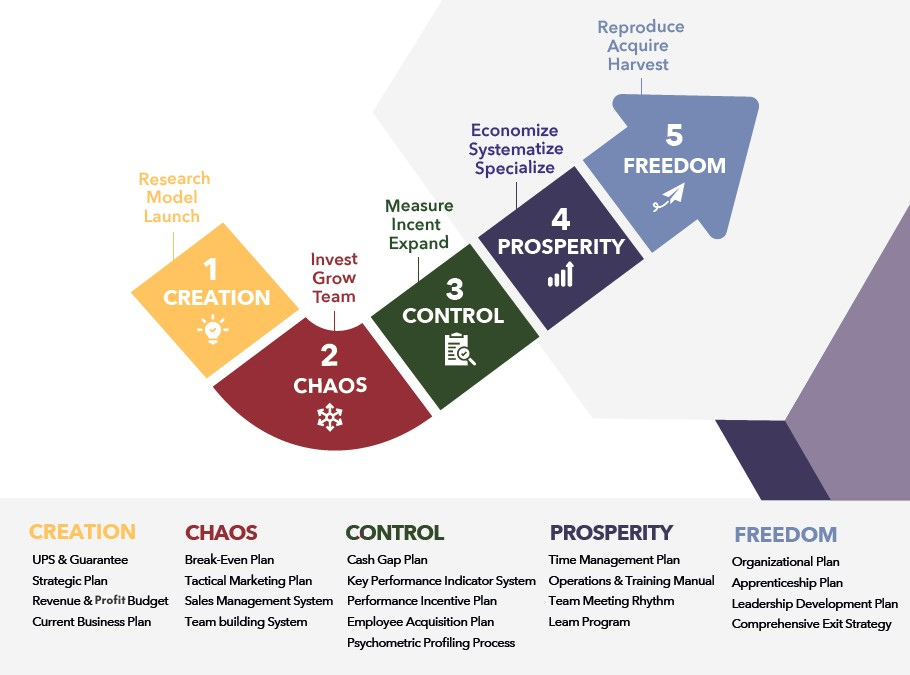
Free Methodology Presentation: Learn Our Proven 5-Step System For Transforming Your Business Into A Firm That Runs Smoothly, Profitably and (mostly) Without You
Free Methodology Presentation: Learn Our Proven 5-Step System For Transforming Your Business Into A Firm That Runs Smoothly, Profitably and (mostly) Without You.
Confirm Your Details To Continue
Confirm Your Details To Continue
Schedule a call to see if our approach can help take your business to #1 in your market.
No pie-in-the-sky. No generic ideas.
No hard sell.
Just straight-forward analysis of your approach to marketing and sales, team-building skills, gross and net profitability, and business transfer readiness.