
BLOG
BLOG

What Version of You Does the Business Need Next?
Most business owners do not hit a market ceiling first.
They hit a leadership ceiling.
A capable, hardworking owner builds something solid. Good clients. Steady revenue. A decent reputation. Maybe even a small team.
Then growth slows.
Not because there is no opportunity left in the market.
But because the business has reached the edge of the skills, habits, systems, and thinking that got it to this stage.
And that is where many owners eventually face an uncomfortable but important reality:
What got you here usually will not get you there.
The Business Starts Reflecting the Owner
Early in business, hustle works.
You work harder. Stay later. Say yes to almost everything. Solve problems yourself. Keep the details in your head. Push things across the line through effort and personal commitment.
And in the beginning, that effort creates momentum.
But eventually, the behaviours that helped build the business start becoming the very things that hold it back.
You become:
the decision-maker for everything
the approval step for every quote, hire, invoice, or client issue
the person the team waits on before moving forward
the one carrying the mental load
the bottleneck for progress
That is when business starts to feel heavy.
Not because you are failing.
Because the business now needs a different version of you.
The week gets consumed by inboxes, phone calls, staff questions, client issues, approvals, and urgent problems; while the work that would actually grow the business keeps getting pushed to “next week.”
Strategy waits.
Marketing waits.
Hiring waits.
Systems wait.
And weekends become the time you use to catch up on the work you could not get to during the week.
That is not a character flaw.
It is often a sign that the business has outgrown the owner’s current operating model.
Building a business is an apprenticeship in leadership.
Every new stage requires new skills, new habits, and a new way of operating.
The version of you that gets a business off the ground is rarely the same version of you required to grow it properly.
The 5 Shifts That Create the Next Version of You
Let’s get practical.
These are five shifts that often unlock the next stage of business growth.
1. Mindset: From Doing the Work to Leading the Work
This is usually one of the hardest transitions for high-performing business owners.
Early on, being hands-on is an advantage.
You know the service. You know the clients. You know the details. You can solve problems quickly because you understand everything better than anyone else.
But over time, staying inside everything becomes the constraint.
The shift is moving from:
doing the work
to
leading the work.
That means:
letting go of unnecessary control
trusting people with clearer outcomes
defining what “good” looks like before work begins
spending less time rescuing and more time building capability
measuring progress by results, not just effort
At a certain stage, leadership becomes more important than simply working harder.
This does not mean effort stops mattering.
It means effort alone no longer scales.
If every important decision still needs to come through you, decision velocity slows. The team becomes dependent. Clients may receive an inconsistent experience. Growth becomes harder because the business can only move at the speed of your personal capacity.
The next level usually requires you to stop being the best problem-solver in the room and start becoming the person who builds better problem-solvers around you.
2. Self-Awareness: Seeing the Real Constraint
Most owners diagnose symptoms before causes.
They say:
“The team isn’t performing.”
“Sales are inconsistent.”
“There’s a communication issue.”
“People just don’t take ownership.”
Sometimes those things are true.
But underneath, the real causes are often more specific:
expectations were never clearly set
accountability conversations were avoided
standards changed depending on the day
feedback was delayed until frustration built up
the owner kept stepping in and unintentionally training dependency
priorities changed too often for the team to follow with confidence
One of the most powerful questions a business owner can ask is:
“Where am I contributing to this problem?”
Not as self-blame.
As leadership.
That question creates space.
It moves the owner from reaction to diagnosis.
Instead of only asking, “Why won’t they do it properly?”, the stronger question becomes:
“Have I made the outcome clear enough?”
“Have I given the person enough context?”
“Have I followed up consistently?”
“Have I allowed poor standards to continue?”
“Am I solving the same problem repeatedly instead of fixing the system underneath it?”
That level of self-awareness changes the business.
The owner becomes calmer.
The team gets clearer.
Meetings become more useful.
Decisions become less emotional.
And often, performance improves faster than expected. Not because the team suddenly changed overnight, but because the leadership environment became more consistent.
3. Structure & Success Habits: Creating Leverage From Your Week
Hard work eventually stops working on its own.
At some point, business growth becomes less about how much effort you put in and more about where that effort is directed.
Without structure, the owner’s week gets pulled apart.
A staff member needs an answer.
A client issue becomes urgent.
A quote needs reviewing.
A supplier problem appears.
A meeting runs over.
Then the important work - sales, marketing, recruitment, financial review, systems improvement, leadership development - quietly slips again.
Nothing dramatic happens in one week.
But over months, the compounding effect is significant.
The business becomes reactive.
Confidence drops.
Second-guessing increases.
Important decisions get delayed.
Opportunities are missed.
The owner feels busy but not always productive.
This is why strong business owners build success habits.
They create structure around the work that matters most.
That may include:
reviewing the numbers weekly
planning the week before it starts
protecting time for sales and marketing
setting a regular rhythm for team meetings
reviewing key projects instead of managing everything by memory
creating space for strategic thinking before the business becomes urgent again
One simple tool I often teach clients is a default diary.
In plain English, this means deciding in advance where your time should go.
Not perfectly.
Not rigidly.
But intentionally.
A good default diary protects the highest-value activities before the week gets taken over by everyone else’s priorities.
You do not always need more hours first.
Often, you need better allocation of the hours you already have.
Small habits compound.
So do poor ones.
4. Leadership: Building a Team That Can Win Without You
If the business only functions properly when you are present, it may still be heavily dependent on you operationally.
That creates risk.
It limits growth.
It slows decisions.
It makes holidays difficult.
It increases stress.
And over time, it can quietly create resentment - toward the team, toward the business, and sometimes toward yourself.
Strong leadership means building a team that can operate with increasing confidence and capability.
That includes:
clear expectations
clear roles
clear standards
regular feedback
consistent accountability
practical coaching
room for people to learn without being rescued too quickly
This is where many owners struggle.
Because solving the problem yourself often feels faster.
Approving the quote yourself feels easier.
Answering the client yourself feels safer.
Fixing the staff issue yourself feels more efficient.
But every time you rescue instead of lead, you may be training dependency into the business.
The team learns to wait.
You learn to carry.
And the business becomes increasingly reliant on your personal involvement.
Real leadership creates:
ownership
initiative
consistency
decision-making capacity
confidence in others
That is where growth lives.
Not in doing more personally.
In increasing the capability of the business around you.
5. Delegation, Communication & Systems: The Growth Engine
Delegation, communication, and systems are tightly linked.
When one is weak, the others usually suffer.
Delegation fails when:
instructions are vague
outcomes are unclear
authority is not defined
timelines are assumed
follow-up is inconsistent
the owner expects people to “just know”
Communication breaks down when:
expectations are implied instead of stated
feedback comes too late
difficult conversations are avoided
priorities constantly change
people receive information in fragments
Systems fail when:
they only exist in the owner’s head
no one follows them consistently
they are too complicated
there is no accountability around them
the team does not understand why the system matters
The commercial impact is real.
Work slows down.
Mistakes repeat.
Clients get inconsistent service.
Margin gets lost through rework.
The owner becomes the quality-control department for everything.
That is exhausting.
But when delegation, communication, and systems improve, the business starts to feel different.
Work flows more smoothly.
Decision-making speeds up.
The team becomes more proactive.
Standards become easier to maintain.
The owner carries less mentally.
Not perfect.
But lighter.
And in a growing business, lighter matters.
Confidence Rarely Comes Before Action
One hidden challenge many business owners carry is constant second-guessing.
Am I doing the right things?
Should I change direction?
Am I wasting time?
Was this the right decision?
Should I hire now or wait?
Should I spend money on marketing?
Should I deal with that staff issue or give it more time?
Business can become mentally exhausting when every decision feels high-stakes.
One framework I often share is:
Hats, Haircuts, and Tattoos.
Some decisions are like hats.
You can try them on, take them off, and change direction quickly.
Some decisions are like haircuts.
They take longer to grow out, but they are recoverable.
Some decisions are like tattoos.
They leave a lasting mark and deserve much deeper consideration.
The mistake many owners make is treating every decision like a tattoo.
So they delay.
Overthink.
Wait for certainty.
Carry decisions for weeks or months that could have been tested safely in days.
But many business improvements come from making smaller, reversible decisions faster.
Test the meeting rhythm.
Trial the marketing activity.
Run the quote follow-up process.
Have the conversation.
Delegate the task with clearer expectations.
Review the numbers weekly for a month.
Confidence is rarely something you magically feel before action.
Confidence is built through:
repetition
accountability
reflection
learning
better decisions
small wins over time
Action creates evidence.
Evidence creates confidence.
The Business Often Grows When the Owner Evolves
In many cases, the next level of business growth requires the owner to evolve first.
That is not criticism.
It is opportunity.
Becoming a stronger owner does not mean:
becoming perfect
working longer hours
knowing everything
removing every problem from the business
It means:
thinking more clearly
leading more consistently
communicating more effectively
building better habits
creating stronger systems
becoming more emotionally resilient
making decisions with more discipline
Small hinges swing big doors.
Sometimes one better meeting rhythm, one clearer role, one difficult conversation, one improved reporting habit, or one better delegation process changes the trajectory of the business.
Not instantly.
But meaningfully.
Because business growth is rarely just operational.
It is personal.
The business changes when the owner changes how they lead it.
A Few Questions Worth Asking Yourself
If growth has slowed, ask yourself honestly:
Where am I still the bottleneck?
What decisions are waiting unnecessarily on me?
What tasks am I holding onto that someone else could own?
Where is the team dependent because I have trained them to be dependent?
What discomfort am I avoiding?
What commercial risk is being created by the business relying too heavily on me?
What skill would create the biggest improvement over the next 12 months?
What would the next-level version of me prioritise differently?
These are not always comfortable questions.
But they are useful ones.
What To Do Next
If this resonates, start simple.
Choose one area where you are currently the bottleneck.
Then create one practical structure to reduce that dependency.
That might mean:
a weekly numbers review
a better team meeting rhythm
a clearer delegation process
a protected sales and marketing block
a documented system for repeated work
one overdue accountability conversation
a regular decision-making rhythm with a mentor, coach, or trusted sounding board
You do not need to transform everything at once.
But you do need to start leading the business at the level the next stage requires.
Most businesses do not stall because the market disappears.
They stall because the owner keeps operating at yesterday’s level while the business requires tomorrow’s leadership.
So the question is simple:
What version of you does the business need next?

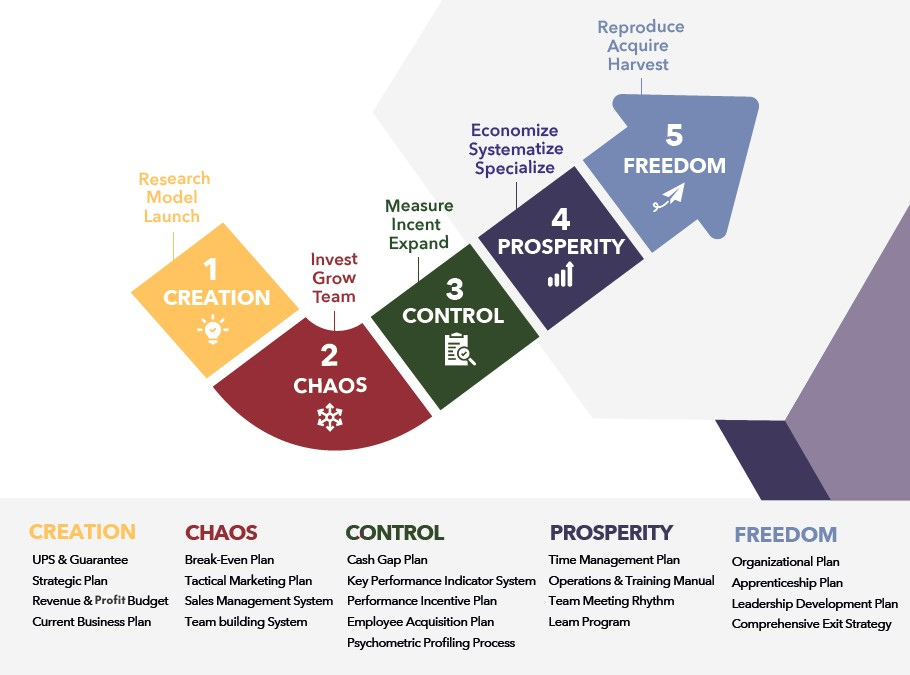
Free Methodology Presentation: Learn Our Proven 5-Step System For Transforming Your Business Into A Firm That Runs Smoothly, Profitably and (mostly) Without You
Free Methodology Presentation: Learn Our Proven 5-Step System For Transforming Your Business Into A Firm That Runs Smoothly, Profitably and (mostly) Without You.
Confirm Your Details To Continue
Confirm Your Details To Continue
Schedule a call to see if our approach can help take your business to #1 in your market.
No pie-in-the-sky. No generic ideas.
No hard sell.
Just straight-forward analysis of your approach to marketing and sales, team-building skills, gross and net profitability, and business transfer readiness.